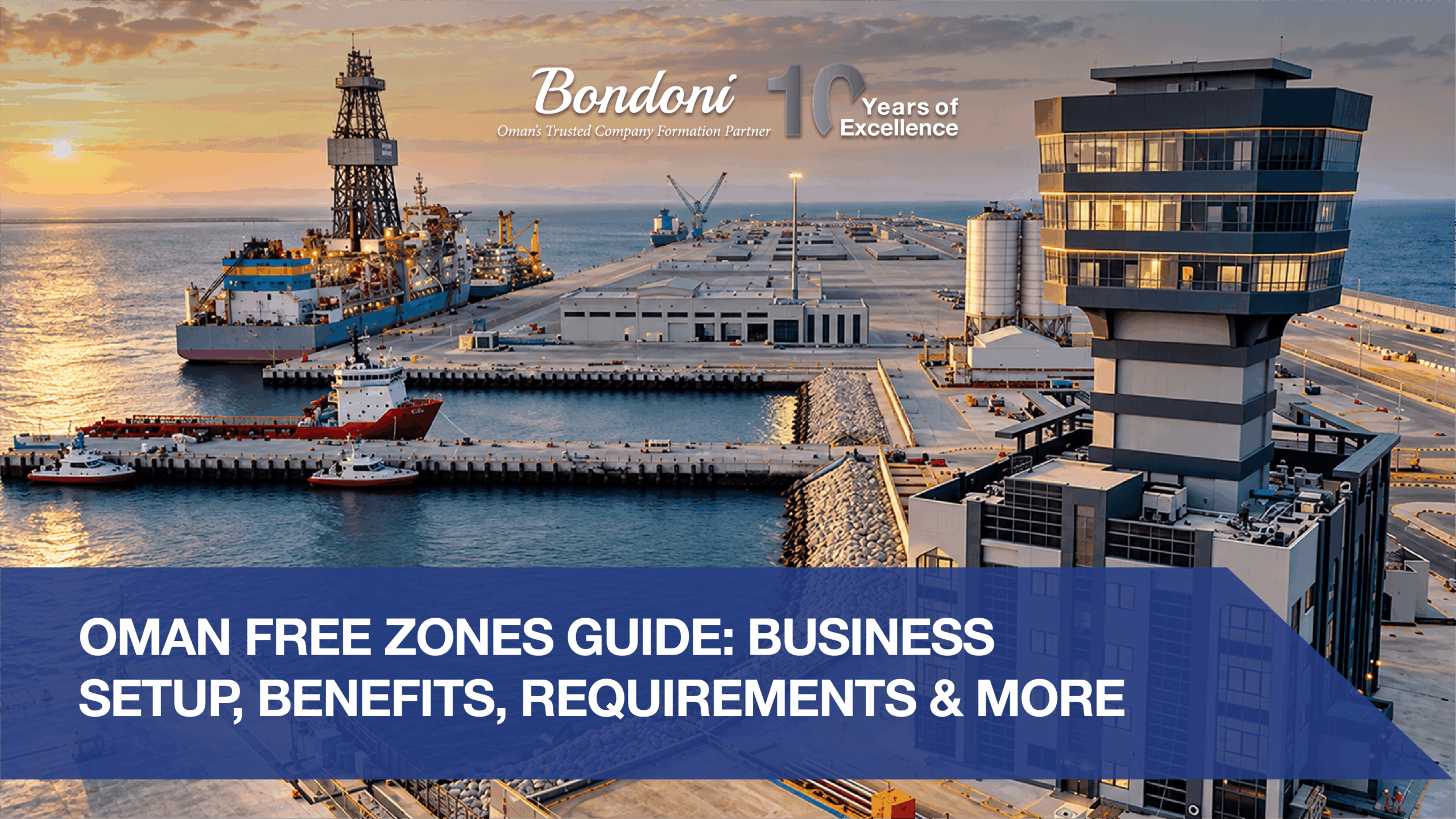

Do you want to open a company in Oman? Your business’s exact location plays an important role in determining your business activities, financial planning, tax obligations, and much more. Setting up your business in Oman’s free zones, however, presents you with various advantages and incentives that may not be available in other parts of the country. Read on to learn more about free zones in Oman, their locations, advantages, setup requirements, and what they mean for your business.
What are Free Zones in Oman?
Free zones in Oman, sometimes referred to as free trade zones, are designated areas for local and foreign investment where businesses can carry out their business activities under specific economic conditions and regulatory requirements, which are typically more favourable to businesses than those applicable in other parts of the Sultanate.
More particularly, Oman’s free zones were developed to encourage foreign investment and support specific industries, with the Public Authority for Special Economic Zones and Free Zones (OPAZ) overseeing and regulating these zones. This aligns with the government’s efforts to diversify the economy as part of its national strategy, Oman Vision 2040.
More details: Exploring Business Opportunities in Oman: Growth Through Vision 2040
Key Free Zones in Oman: Comprehensive Overview
Oman has four major free zones, each focusing on different industries and offering varying advantages based on location, infrastructure, and other factors. Here’s a brief overview of each one of them:
1- Sohar Free Zone
Sohar free zone is located in Sohar, Al Batinah North Governorate, northern Oman. Situated near Sohar Port, it offers road connections to the wider GCC market as well as convenient access to marine trade routes, connecting the country to Europe, Asia, and the broader Gulf region.
But what makes this location even more advantageous is that the zone sits outside the Strait of Hormuz, providing direct access to international shipping routes and helping businesses reduce exposure to regional maritime disruptions and supply chain risks.
Sohar free zone also provides office spaces, pre-built warehouses, and industrial land plots, among other commercial and industrial facilities that support companies with their setup and operations. Considering its location and infrastructure, this area is a growing hub for the metals and minerals industry, petrochemicals and plastics, and logistics and warehousing, among other sectors.
2- Duqm Free Zone
The Special Economic Zone at Duqm (SEZAD) is one of Oman’s largest investment destinations, spanning nearly 2,000 sq. km along the Arabian Sea, with access to the Indian Ocean and major international shipping routes.
It comprises the Port of Duqm, a dry dock, industrial and logistics zones, fisheries and food industries, tourism areas, Duqm Airport, refinery and petrochemical facilities, and commercial and residential developments.
The zone is particularly suited to manufacturing, logistics, petrochemicals, fisheries, mining, tourism, renewable energy, and other industrial projects.
It is suitable for both local and international investors, including SMEs, large industrial projects, and companies seeking access to regional and international markets.
Investors can benefit from incentives including up to 100% foreign ownership, tax and customs exemptions, no minimum capital requirement, and long-term land usufruct arrangements.
3- Salalah Free Zone
Salalah free zone in Oman is located in Salalah, Dhofar Governorate, southern Oman, on the Arabian Sea. Situated near the Port of Salalah, this area is strategically positioned along major east-west shipping routes, providing strong connectivity to international markets across Asia, Africa, and Europe.
What makes Salalah’s free zone location particularly strategic is its proximity to the Salalah International Airport. Along with its port access, this creates a sea-air connection that is highly valuable for various business activities. This integrated connectivity also supports faster and more flexible movement of goods between local and international markets.
That said, this free zone operates across two distinct development sites, each focusing on different sectors. First is the Raysut site, which is more focused on heavy industrial and chemical sectors. Second is the Adhan site, which caters more to technology, services, office-based businesses, and logistics.
4- Al Mazunah Free Zone
The Al Mazunah free zone is located in Al Mazunah Wilayat, Dhofar Governorate, southwestern Oman, right by the Oman–Yemen border. This zone has no direct access to the sea and is entirely land-based, unlike the first three zones. Leveraging its position, it focuses primarily on the flow of goods between Oman and Yemen as well as transit trade towards the GCC and East Africa.
As for the infrastructure, it is mostly known for the Mazunah Dry Port, which supports the movement of goods across the Oman–Yemen border through customs inspection, cargo handling, and logistics services. The free zone is also equipped with commercial facilities and specialised sites for specific trades and business activities, such as the Automotive Complex for selling and distributing private vehicles, the Unified Common Market Area for retail stores, and much more.
Taking advantage of its location and available infrastructure, Al Mazunah free zone supports activities in light industrial processing and manufacturing, food-related industries, commercial trade, and logistics.
Oman Free Zone Business List: Focus Activities and Business Types
The following categories explain the types of business activities that can be carried out in Oman’s free zones, giving you a clearer picture of the types of businesses that can operate in these areas:
1. Manufacturing and Industrial Activities
These activities generally include producing, processing, assembling, and packaging goods. They are supported in Oman’s free zones, making these areas suitable for businesses such as food and beverage manufacturers, metal and mineral processing companies, petrochemical and plastics manufacturers, packaging manufacturers, and other businesses involved in industrial production.
2. Trading and Commercial Activities
Thanks to their location, free zones in Oman support a range of trading and commercial activities, including importing, exporting, re-exporting, wholesaling, retailing, and distributing goods. As such, these zones are suitable for import and export companies, wholesale trading companies, retailers, consumer goods distributors, automotive trading companies, and food and beverage trading companies, among many others.
3. Logistics and Warehousing Activities
Another important category is logistics and warehousing activities, which cover cargo handling, transportation and distribution, inventory management, and supply chain management, in addition to other relevant activities. Considering the infrastructure and supporting facilities available in Oman’s free zones, they can accommodate third-party logistics (3PL) companies, warehousing companies, distribution companies, and supply-chain management providers.
4. Food and Agriculture-Related Activities
These include food processing, manufacturing, packaging, and food distribution, as well as agricultural product processing and agro-food logistics. Free zones in Oman support these operations through access to regional and international markets, dedicated facilities, and established logistics infrastructure. This makes them suitable for food processing companies, food and beverage manufacturers, food distributors, agricultural product processors, and agro-food logistics companies.
5. Services and Technology
These generally cover professional and business services, IT and software solutions, technology development, data-centre operations, and other related services. They especially align with the overall framework of Oman Vision 2040, which encourages relevant companies to start operations in the country. Some of these include IT companies, technology solution providers, consulting firms, and other professional service providers.
It is important to note that not all activities are equally available across all of Oman’s free zones. Therefore, you should check the scope of permitted business activities for each zone before proceeding with business setup.
Benefits of Setting Up a Business in an Oman Free Zone
Starting a business in one of the free zones in Oman presents you with various practical benefits, paving the way for business growth and improved profitability. Here are some of these benefits:
Tax Incentives
One of the key benefits of starting a company in Oman’s free zones is the tax incentives available to qualifying businesses. For instance, companies established in these zones can benefit from income tax exemptions.
More information: Corporate Tax in Oman: A Practical Guide for New Businesses
Customs Duty Exemptions
Since many of the activities carried out in Oman’s free zones involve importing and exporting goods, they are further facilitated by customs duty exemptions. These exemptions, while subject to applicable requirements, can help reduce the costs associated with moving goods into and out of free zones, allowing businesses to make better use of their location and access to regional and international markets. This benefit further supports the business environment in Oman’s free zones, particularly for manufacturing, trading, and logistics companies.
Further details: Business Environment in Oman: Opportunities and Challenges
Repatriation of Capital and Profit
Free zones in Oman allow for the repatriation of capital and profits, subject to applicable rules and regulations. This is particularly advantageous for foreign investors, as they can transfer their invested capital and profits outside Oman when needed, giving them greater flexibility in managing funds generated through their free-zone companies. While this flexibility is also available to businesses operating on the mainland, it adds to the range of investment benefits offered by Oman’s free zones.
Strategic Market Access
Oman’s free zones offer streamlined connectivity and access to regional and international markets through sea, land, and air. The exact accessibility varies from one zone to another, depending on its specific location and available infrastructure. Despite these variations, this connectivity gives businesses greater flexibility in reaching customers, suppliers, and trading partners across different markets, while supporting the movement of goods and facilitating international trade.
Simplified Business Setup
The Public Authority for Special Economic Zones and Free Zones (OPAZ) has made company setup in Oman’s free zones simpler and easier through the One-Stop Shop system. This electronic system, established by OPAZ, is linked electronically with other relevant official systems and provides one central government platform through which investors can proceed with procedures related to licences, permits, company registration, and more, instead of dealing with different platforms and authorities separately for each procedure.
Oman Free Zone Company Requirements
Here is a brief list of the requirements needed for opening a company in Oman’s free zones:
- The business activity the company is planning to conduct, which is essential for completing the Oman free zone company registration.
- A proper business structure that aligns with the company’s needs and scope of activities, such as an LLC, SPC, or branch office.
- Shareholder identification documents, such as passports for non-Omani shareholders and ID cards for Omani shareholders.
- Additional documents for the parent company, where applicable.
- Sector-specific licences and permits, as dictated by the relevant authorities.
Keep in mind that these requirements vary by zone and the applicable rules and regulations.
Read more: How to Set Up a Branch Office in Oman: Step-by-Step Guide
Learn more: Sector-Specific Licences & Approvals in Oman
How to Set Up a Company in an Oman Free Zone
Setting up a free zone company in Oman follows a similar sequence to that in the mainland. Companies must choose their target free zone, specific business activities, and corporate structure before preparing the required documentation.
Then, all these requirements are submitted through an online application electronically, using the OPAZ Zone Services Portal, which is governed by the One-Stop Shop system. The application is then reviewed centrally, after which businesses proceed with registration and the acquisition of required additional licences.
FAQs about Free Zones in Oman
Here are some of the most commonly asked questions and their answers:
Can foreigners own 100% of a company in free zones in Oman?
Yes, foreign investors can fully own their companies in Oman’s free zones, as setting up a business does not require a local partner.
Can free zone companies in Oman do business on the mainland?
No, free zone companies in Oman cannot do business on the mainland the same way they do in these zones. Restrictions and limitations apply, and businesses can navigate them through some legal procedures, depending on their activities.
What is the cost of an Oman free zone company setup?
The cost of an Oman free zone company setup depends on various factors, including the chosen free zone, business activity, company structure, and needed facilities. The cost also varies according to fees associated with licences, registration, and visa acquisition.
Can an Oman free zone company open a bank account?
Yes, companies established in Oman’s free zones can open a corporate bank account, but only after completing their commercial company registration and receiving their operating licence.
Expanding Your Company in Oman’s Free Zones with Bondoni
Bondoni provides company formation services for foreign-owned companies establishing their presence in the mainland, while also offering corporate and PRO services to advise and guide your company in the free zone with its corporate services and back-office operations, allowing you to focus on your core business activities instead. These services cover a wide range of areas, such as customs clearance, Omanisation and HR strategy, and document renewal.
Want to know more? Consult our team today to learn how we can help your business grow.
Read more: What Are Corporate Services in Oman? A Complete Guide for Businesses
Further insights: Choosing the Right Business Entity in Oman: A Complete Guide
Explore details: How to Open a Bank Account in Oman for Companies: A Comprehensive Guide